Why Security Is the Ultimate
Differentiator for Enterprise AI Agents
5 Min Read

April 29, 2026
In the rush to deploy AI agents, many organizations are focused on speed, automation, and productivity gains. Those things matter. But they only matter if the system can be trusted.
For agentic AI, security is not a back-office requirement or a compliance checkbox. It is the foundation that determines whether an organization can confidently move from experimentation to real operational use.
AI agents are different from traditional software because they do not simply display information. They can interpret intent, access data, interact with systems, trigger workflows, and complete tasks on behalf of users. That makes security more important, not less.
At Zammo.ai, security has always been central to how we build.
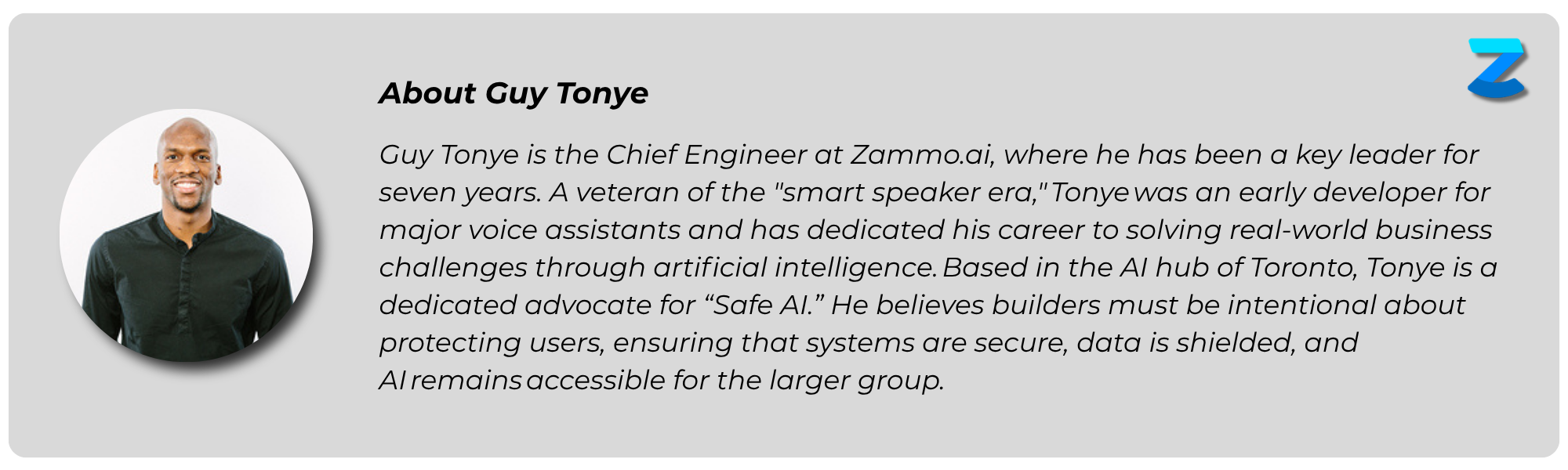
As Guy Tonye, Chief Engineer at Zammo.ai, explains:
“Security is not something we think about at the end. It has to be part of the architecture from the beginning, because our platform supports customers, partners, and Microsoft environments. That responsibility has to shape every decision we make.”

Security Has to Be Built Into the Culture
A secure product starts with the people who build it.
At Zammo, security is not owned by one person, one checklist, or one annual audit. It is part of the engineering culture. Every architecture decision, integration pattern, deployment model, and product feature is evaluated through the lens of trust, control, and risk reduction.
That matters because AI agents are only as safe as the systems around them. The model is one part of the equation. The architecture, permissions, data boundaries, logging, deployment environment, and integration controls are just as important.
As Guy puts it:
“Good security is not one big decision. It is a thousand small decisions made consistently by people who understand what is at stake.”
The Customer Tenant Is a Major Security Advantage
One of Zammo’s most important security differentiators is its Azure-native, customer-tenant architecture.
Many AI solutions require organizations to move data into an external SaaS environment. That can introduce additional risk, complexity, procurement concerns, and governance questions. Zammo takes a different approach.
Zammo is designed to run within the customer’s own Azure tenant, allowing organizations to keep their data inside the environment they already control. Their existing security policies, identity management, access controls, networking rules, compliance processes, and governance standards remain central to the deployment.
This is not just a technical architecture choice. It is a trust strategy.
By keeping the AI experience closer to where the customer’s data and systems already live, Zammo helps reduce unnecessary data movement and gives organizations greater control over how agents are deployed, accessed, monitored, and governed.
“Our customer-tenant model is about giving organizations control. Their data stays in their environment, under their security standards, with the governance they already trust.”
For regulated industries, public sector organizations, higher education institutions, and enterprises with strict data requirements, that distinction matters.

SOC 2 Is More Than a Badge
Zammo has successfully completed SOC 2 Type II compliance for the second year in a row.
SOC 2 is an important signal to customers, but internally, Zammo sees it as more than a certification. It is a discipline. It requires the organization to prove that security processes are not theoretical, occasional, or dependent on memory. They have to be documented, repeatable, monitored, and continuously improved.
Guy describes SOC 2 as a kind of operational training ground:
“SOC 2 is like a dojo. You do not pass it once and move on. You have to keep showing up, keep proving the process, and keep strengthening the discipline every year.”
That mindset matters because security is not static. Threats evolve. Products evolve. Customer needs evolve. A strong security program has to evolve with them.
You can request access to Zammo’s SOC 2 report by visiting our Trust Center.
External Testing Helps Find What Internal Teams Might Miss
Even strong internal teams can have blind spots. That is why external testing is essential.
Penetration testing gives companies the opportunity to bring in outside experts who actively look for weaknesses, attack paths, and vulnerabilities that may not be obvious from the inside. The real value is not just in completing the test. It is in understanding what the test reveals.
For AI platforms, this is especially important because risks can emerge across multiple layers: the application, infrastructure, permissions, APIs, data access, agent behavior, and connected systems.
“The value of penetration testing is perspective. It shows you the attack paths you may not have seen because you are too close to the product.”
At Zammo, that outside perspective helps reinforce a security posture built around resilience, continuous improvement, and responsible deployment.

Agentic AI Introduces New Security Risks
AI agents create powerful new opportunities for organizations, but they also introduce new risks if deployed without the right guardrails.
An insecure or poorly governed agent can create serious issues, including:
Data exposure.
If an agent has access to sensitive information without proper controls, it can become a pathway to data that should remain restricted. At Zammo, all data interactions are handled through dedicated tools rather than directly by the agent. This means every data access is traceable, properly permissioned, and credentials are never exposed to the agent itself.
Unauthorized access.
Without scoped permissions, an agent may provide information to the wrong person or expose private records, such as HR, financial, student, patient, or customer data. By routing all data interactions through controlled tools, Zammo ensures that access boundaries are enforced at the integration layer, not left to the agent to manage on its own.
Unintended actions.
Agents that interact with systems need clear limits. Without proper controls, they could trigger actions, make updates, route requests, or change records in ways that create operational risk.
Lack of auditability.
If organizations cannot see what an agent accessed, what tools it used, or what actions it took, they cannot confidently govern or troubleshoot the system.
Overly broad integrations.
Connecting an agent to enterprise systems without careful permissioning can create unnecessary exposure and risk. For any browser-based interactions, Zammo uses a sandboxed browser that runs web requests in an isolated environment, ensuring that browsing activity cannot become an entry point for broader system compromise.
This is why agentic AI cannot be treated like a simple chatbot. Once an agent can act, integrate, retrieve data, or complete tasks, security must be designed into every layer of the experience.

Safe AI Builds on Proven Security Principles
The future of AI security is not about abandoning decades of software best practices. It is about applying those principles to a new class of intelligent systems.
At Zammo, that means building with intentional controls such as scoped permissions, sandboxed environments, governed tool calls, secure integrations, auditability, and customer-controlled deployment models.
Agents should only access the data they need. They should only take actions they are authorized to take. Their interactions with external systems should be controlled, observable, and governed. And organizations should be able to understand how the agent is operating inside their environment.
“Trustworthy AI is not magic. It is architecture, discipline, governance, and control.”
That is the difference between AI that looks impressive in a demo and AI that enterprises can actually use.
Security Is What Makes AI Adoption Possible
The organizations moving fastest with AI will not be the ones that ignore security. They will be the ones who build on a foundation strong enough to support real adoption.
For Zammo, security is not a constraint on innovation. It is what makes innovation usable.
Because when AI agents are trusted, governed, and securely deployed, they can move beyond experimentation and begin solving real problems across the enterprise.
That is the future Zammo is building toward: powerful AI agents that help organizations move faster without asking them to compromise control, security, or trust.